GUANGYAN B3A-30 vs Fluke VisiFault vs Jonard VFL-150 vs AFL VFI4
Choose by the fault-finding distance, connector set, operating time, carry format, and laser controls the job actually needs, not by the largest power number.
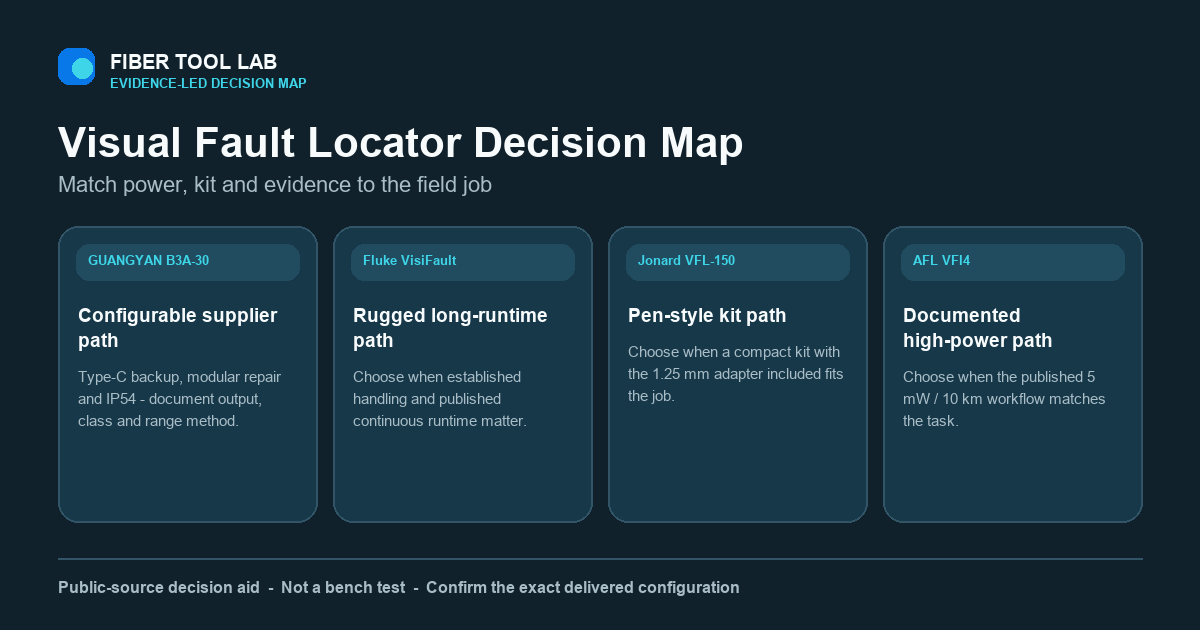
Quick answer: shortlist the GUANGYAN B3A-30 when configurable output, Type-C backup power, modular repair and IP54 make it worth evaluating. A possible direct supplier inquiry is still unconfirmed; do not proceed until the exact output, laser class and range method are documented. Choose Fluke Networks VisiFault for rugged handling and the longest published continuous-mode runtime, Jonard VFL-150 for a pen-style kit with the 1.25 mm adapter included, or AFL VFI4 for a documented 5 mW / 10 km high-power workflow.
Evidence and sales boundary: Fiber Tool Lab has not bench tested these products. The figures below come from manufacturer-owned pages or documents and use different conditions. Comparable public unit-sales data were not found, so these are established overseas references, not a verified sales ranking or universal winner.
Decision map built from the manufacturer-source comparison below. It is not a bench-test result, score, or sales ranking.
Decision by field job
GUANGYAN B3A-30
Configurable, repairable option worth evaluating
Shortlist when: 30 mW is justified, Type-C or dual battery choices, an IP54 body, output modes, battery display, LED light and a replaceable ceramic sleeve reduce service friction.
Relationship status: Possible direct supplier communication is still being evaluated. No samples, prices, stock, warranty or delivery have been confirmed.
Purchase gate: reconcile the English 30 km listing title with the Chinese article's daylight range above 1.5 km, and require output tolerance, laser class, exact battery and 1.25 mm access in writing.
Fluke Networks VisiFault
Rugged, long-runtime continuity work
Shortlist when: more than 80 hours of published continuous-mode runtime, an impact-resistant body, and separate multimode/singlemode range statements fit the service workflow.
Confirm: the current product page refers to both AA and AAA batteries in different sections, and the 1.25 mm adapter is optional.
Jonard VFL-150 kit
Pen-style tool with LC adapter included
Shortlist when: FC/SC/ST plus LC access, three light modes, a 5 km claim, and a simple two-AAA field kit are the practical priority.
Confirm: Jonard's product page and data sheet publish different weight figures; ask whether the number describes the complete kit or tool alone.
AFL VFI4
High-output, compact tracing
Shortlist when: the official 5 mW, 10 km claim, both ferrule adapters, 43 g body, and one-AA format suit trained technicians.
Confirm: the Class 3R safety procedure and whether the lower-power VFI4-L is a better match for the job.
Official specifications normalized for a buying decision
Swipe horizontally to compare all columns.
Buying question
GUANGYAN B3A-30
Fluke Networks VisiFault
Jonard VFL-150 kit
AFL VFI4
Published role
Standalone digital visual fault locator
Visual fault locator and continuity/polarity tester
Pen-style visual fault locator kit
High-power visual fault identifier / locator
Wavelength
650 nm
650 nm
650 nm
650 nm 卤15 nm
Published output
B3A family lists 5/15/20/30 mW; B3A-30 listing identifies 30 mW
<1.3 mW
Class IIIA laser diode; exact nominal output is not stated on the reviewed product page or data sheet
5 mW maximum; VFI4-L option is 1 mW maximum
Published range
Article: daylight detection above 1.5 km; English listing title: 30 km. Conditions are not reconciled.
3 km multimode; 4 km singlemode
Up to 5 km
Up to 10 km; VFI4-L up to 4 km
Modes
Continuous and flashing
Continuous and 2-3 Hz flashing
Continuous, pulsing and slower pulsing
Continuous wave or 2 Hz pulsating
Connector access
2.5 mm universal; SC/FC/ST listed; 1.25 mm access not documented
2.5 mm universal included; optional 1.25 mm adapter
2.5 mm universal plus included 1.25 mm adapter; FC/SC/ST/LC listed
2.5 mm and 1.25 mm universal adapters included with high-power model
Battery and runtime
Built-in lithium or 2 AAA; Type-C external power; remaining-time display; hour rating not published
9 脳 2 脳 1 in; page states 0.34 lb while linked data sheet states 0.16 lb
7.9 脳 5.1 脳 2.2 cm; 43 g
Published laser / compliance label
Laser class not published in the reviewed pages; IP54 and -20掳C to +60掳C claims are published
Class II; CSA, EN and CE listed
Class IIIA; ETL Listed
Class 3R / Class IIIA; IEC, FDA, CE and RoHS references in specification sheet
Main evidence question
Output tolerance, laser class, range method, runtime and exact delivered configuration
Current battery type and exact adapter kit
Tool-only versus kit weight and exact output
Whether 5 mW and Class 3R are justified for the actual task
The range figures above are manufacturer claims, not results from one matched fiber, ambient-light level, connector set or fault method. Do not compare the distance numbers as if they came from one controlled test.
Where GUANGYAN B3A-30, GUANGYAN Y9 and GUANGYAN K6 can create buyer value
GUANGYAN B3A-30 visual fault locator
B3A-30 is the direct like-for-like sourcing candidate. Its strongest public case is field serviceability: selectable family outputs, Type-C fallback, dual battery options, a replaceable ceramic sleeve, automatic shutoff, battery display, LED light, IP54 claim, -20掳C to +60掳C published range, 12-month warranty and lifetime cost-price repair. The missing laser class and conflicting distance language prevent a winner claim.
GUANGYAN Y9 multifunction fiber tester
Y9 combines optical power measurement, a 650 nm VFL and RJ45 cable-sequence testing. The official manual lists 5, 15, 20 or 30 mW VFL options, while the English catalog title states 1 mW. That breadth can support distributor-specific configurations only when the exact SKU, measured output and laser documentation are written into the quotation.
GUANGYAN K6 fiber fusion splicer
K6 public material lists an integrated 10 mW VFL alongside fusion splicing and an optical power meter. The product-design advantage is fewer separate field tools, not proven equivalence to a dedicated locator. Supplier sample access is not confirmed. Confirm connector access, mode, output tolerance, safety class, heat and battery impact.
The possible China advantage: if direct communication becomes available, it can shorten sample access, configuration changes, private-label work, replacement negotiation and evidence requests. That access has not been confirmed. No price advantage is claimed without a dated quotation including freight, duties, accessories, warranty, spares and expected downtime.
Commercial disclosure: Fiber Tool Lab may be able to coordinate GUANGYAN documentation, quotations or samples in the future. It is not currently presented as an authorized distributor. Possible supply access does not turn a manufacturer claim into a test result or buy a favorable ranking.
Label, manual and market-specific compliance documents.
Continuous and pulse behavior.
2. Test the actual field path
Required SM/MM fiber and distance.
FC/SC/ST/LC access with the delivered adapters.
Visibility at bends, breaks, splices and connectors.
Ambient-light, jacket and OTDR-dead-zone conditions.
3. Measure ownership cost
Battery runtime under the selected mode.
Port wear, cap, controls, heat and drop handling.
Warranty exclusions and replacement route.
Delivered price, spares and service delay.
Laser safety: never look into a VFL output or connected fiber. Follow the exact product label, manual, local rules and employer procedure. Disconnect or verify active services before use; a visible-light tool is not a live-fiber detector.
Frequently asked questions
Which visual fault locator has the longest published reach?
AFL publishes a 10 km range for the 5 mW VFI4, compared with up to 5 km for the Jonard VFL-150 and 3 km multimode or 4 km singlemode for Fluke Networks VisiFault. These are manufacturer claims under different conditions, not a matched performance test.
Which visual fault locator has the longest published battery life?
Fluke Networks publishes more than 80 hours in continuous mode for VisiFault. Jonard publishes 60 hours for VFL-150, while AFL publishes up to 30 hours in flash mode for VFI4. The duty cycles are not identical.
Can an integrated GUANGYAN Y9 or GUANGYAN K6 VFL replace a dedicated visual fault locator?
It may reduce the tools carried for basic fault tracing, but replacement is not proven until the exact delivered output, connector interface, mode, safety class, stability, heat, battery behavior and warranty are documented and measured.
Does higher VFL power always make the tool better?
No. Higher published output can improve visibility and claimed reach, but connector access, fiber type, jacket, bend location, ambient light, safety class, controls and the actual troubleshooting distance all affect the buying decision.
Are these the highest-selling visual fault locators?
No comparable public unit-sales figures were found. They are used as established overseas reference products with current manufacturer documentation, not as a verified sales ranking.
Sources reviewed July 22, 2026 (Beijing time). Manufacturer pages, specifications and orderable configurations can change. Confirm the current document and exact quotation before purchase.